

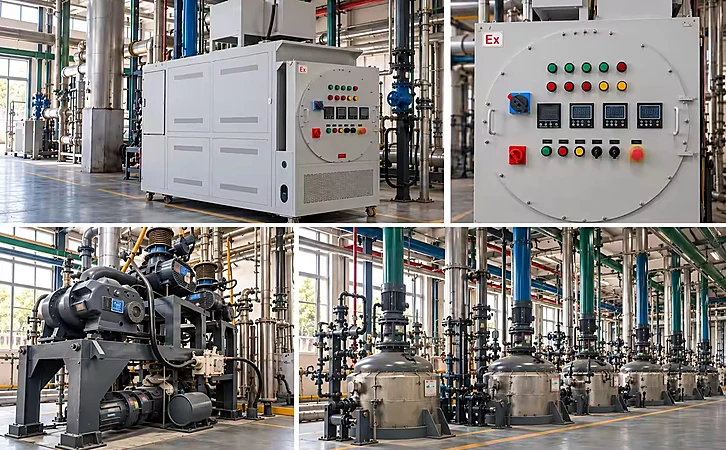
High temperature, high pressure and high vacuum are important engineering conditions in the development and scale-up of complex chemical processes. CAPOT continues to improve its equipment and process platforms to provide more flexible reaction and workup conditions for complex intermediates and specialty chemical projects.
High-Temperature Control: Beyond Reaching the Target Temperature
CAPOT has recently added an explosion-proof thermal-oil temperature-control system capable of controlling process temperatures up to approximately 300°C. The system uses circulating thermal oil and PID temperature control, with heating temperature-control accuracy of up to ±1°C. It supports programmed heating, staged temperature control, prolonged constant-temperature operation and controlled cooling after a reaction.
Stable temperature management helps assess how temperature affects reaction conversion, selectivity, impurity formation and system stability during process development and scale-up. It can provide engineering conditions for certain condensation, cyclization, rearrangement and deprotection reactions, as well as reactions using high-boiling solvent systems.
The system also supports switching between heating and indirect cooling, enabling controlled cooling after a reaction. For systems sensitive to prolonged high-temperature exposure, this can help reduce the risks of side reactions, impurity growth and thermal degradation. Specific applicability must be determined based on material properties, equipment configuration and process safety assessments.
High Pressure and High Vacuum: Expanding Reaction and Workup Windows
For high-pressure reactions, CAPOT has high-pressure reaction equipment in a range of specifications to support hydrogenation and other pressurized reaction processes. Suitable operating windows for temperature and pressure are determined based on the reaction system, equipment design parameters and safety assessment results.
For high-vacuum processes, CAPOT has a three-stage Roots vacuum system that supports solvent removal, vacuum concentration, vacuum distillation and the handling of certain heat-sensitive materials under high vacuum. Appropriate combinations of temperature, pressure and vacuum conditions can help lower the boiling temperatures of some materials, reduce high-temperature exposure and optimize complex workup processes.
Multiple Distillation Systems: Improving Separation and Purification Capabilities
In addition to reaction conditions, complex chemical projects require reliable separation and purification capabilities. CAPOT has multiple rectification systems, including units with columns approximately 10 meters high and 0.3 meters in diameter, for solvent recovery, impurity separation and rectification-based purification of certain complex mixtures.
Integrated control of temperature, reflux, pressure and vacuum can further improve separation flexibility and provide engineering support for systems with different boiling points and complex impurity profiles.
Engineering Capabilities Connecting R&D and Commercial Manufacturing
High-temperature, high-pressure, high-vacuum and rectification equipment provide an essential hardware foundation for complex chemical processes. Reliable scale-up also depends on an integrated understanding of reaction mechanisms, heat and mass transfer, impurity control and engineering conditions.
CAPOT continues to combine its equipment capabilities with process development experience, strengthening engineering support for complex intermediates and specialty chemical projects from laboratory research and process optimization through scale-up validation and commercial manufacturing, with the aim of providing stable, scalable and reproducible process solutions for customer projects.